


THCV (Tetrahydrocannabivarin): The Cannabinoid That Breaks Its Own Rules
THCV — tetrahydrocannabivarin — is the minor cannabinoid that made the internet start calling weed a diet aid. It sits one molecular hair away from THC, yet it does close to the opposite job at low doses: instead of switching your CB1 receptors on, it politely blocks them. That single structural difference is why THCV has its own research literature, its own reputation for a clear, short-fused buzz, and a nickname it only half deserves. This guide covers what THCV actually is, what the peer-reviewed science does and does not show, and where it fits next to the cannabinoids you can actually buy — like the THCA flower Diesel Hemp grows.
Quick Facts
In short: THCV is a propyl cannabinoid — THC's three-carbon cousin. At low doses it blocks CB1 receptors and is essentially non-intoxicating; at higher doses it flips and produces a short, clear, stimulating high. Real research exists on appetite, blood sugar and motor symptoms, but it is early-stage.
- Full name: Tetrahydrocannabivarin (Δ9-THCV)
- Formula: C19H26O2 — a 3-carbon (propyl) side chain vs. THC's 5-carbon (pentyl)
- Acid precursor: THCVA, made from CBGVA — the varin-series parallel to CBGA
- Psychoactive? Dose-dependent — blocking at low doses, mildly intoxicating at high doses
- Typical plant content: Usually under 0.2%; trace or undetectable in most modern cultivars
- Boiling point: ~428°F (220°C) — noticeably higher than THC's 315°F
- Best-known source: African and South/Southeast Asian landraces — Durban Poison is the classic example
A 360° look at the golden crystalline form isolated cannabinoids like THCV take.
Shop Lab-Tested Hemp Cannabinoids
Diesel Hemp does not sell a THCV product. These are the lab-tested hemp cannabinoid products we do grow and ship.
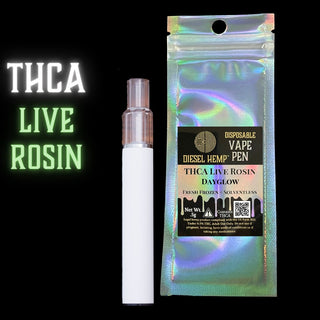
THCA Live Rosin Vape Pen (.5g)
From $44.00
SHOP NOW →
THCA Flower – Lemon Cherry Gelato
From $69.00
SHOP NOW →
THCA Flower – Super Boof
From $29.00
SHOP NOW →
THCA Flower – Straw Gua Mintz
From $29.00
SHOP NOW →
CBD Flower – Abacus Diesel
From $8.00
SHOP NOW →
THCA Pre Roll – King Size
From $9.00
SHOP NOW →
THCA Flower Bundle
From $89.00
SHOP NOW →Why Buy From Diesel Hemp
- Third-party lab tested — published COAs from ISO 17025-accredited labs on every batch
- Small-batch, dispensary-grade flower — AAA indoor, hand-trimmed, shipped fresh
- Straight answers about cannabinoids — we tell you what we don't carry, too
- Ships direct in discreet packaging — free shipping on orders over $75
- Veterans discount program — proud to support those who served — apply here
Shipping & Legality
Do Diesel Hemp products contain THCV?
No. Diesel Hemp does not currently offer a THCV product. Our catalog is THCA flower, CBD flower, Delta-8, pre-rolls, vapes and concentrates — each with a published third-party COA showing exactly what is in it.
Is it legal to ship hemp flower to my state?
In raw form our THCA flower contains less than 0.3% delta-9 THC, making it federally compliant under the 2018 Farm Bill. Some states restrict high-THCA and intoxicating hemp products — check your local laws before ordering.
Questions about your order?
Call 833-375-3835 or email info@dieselhemp.com — real humans in Loveland, Colorado.
What Is THCV?
THCV is one of the roughly 100-plus phytocannabinoids the cannabis plant produces, and it belongs to a smaller family within that group called the varins. Varin cannabinoids are the short-tailed versions of the ones you already know: THCV to THC, CBDV to CBD, CBGV to CBG. They are chemically legitimate plant compounds, not lab inventions — which matters, because a lot of what gets sold as a "novel cannabinoid" is not.
What makes THCV interesting is that it does not behave like a weaker THC. It behaves like a different drug that happens to look like THC. Pharmacology work published in the British Journal of Pharmacology established that THCV acts as an antagonist at both CB1 and CB2 receptors at the doses tested — it occupies the receptor without activating it. Push the dose high enough and that flips: THCV starts acting as a partial agonist and produces THC-like effects. One molecule, two opposite jobs, decided by how much you take.
The practical consequence is that "does THCV get you high" has no single answer. It depends entirely on dose, which is exactly the kind of nuance that gets flattened out of product marketing.
THCV vs THC: The Propyl Side Chain That Changes Everything
Line THCV up against THC and the molecules are nearly identical. Same tricyclic core, same ring system, same everything — except the alkyl tail hanging off the aromatic ring. THC has a five-carbon (pentyl) side chain. THCV has a three-carbon (propyl) side chain. Two carbons. That is the whole difference.
Two carbons turn out to matter enormously, because that tail is what seats the molecule into the CB1 receptor's binding pocket. Shorten it and the fit changes — the molecule still slots in, but it no longer triggers the conformational change that switches the receptor on. It sits in the doorway instead of walking through. That is the mechanical basis for the low-dose antagonism, and it is also why THCV's high, when you reach it, comes on faster and clears out faster than THC's.
Users consistently describe the high-dose THCV experience as sharper and more stimulating than THC's — closer to a strong coffee than a heavy indica — and roughly half as long-lasting. It is the difference between a compound that settles into your receptors and one that bounces off them.
Worth being clear about what THCV is not: it is not THCP, which goes the other direction with a seven-carbon chain and binds CB1 far more powerfully than THC. THCV and THCP are chemical opposites that happen to sit on the same shelf.
How THCV Is Made: From CBGVA to THCVA
Cannabis does not synthesize THCV directly. It builds it the same way it builds everything else — through an acidic precursor pathway that only becomes psychoactive when you apply heat.
The mainline pathway you already know runs CBGA → THCA → (heat) → THC. The varin pathway runs alongside it using a different starting acid:
- Divarinolic acid + geranyl pyrophosphate → CBGVA (cannabigerovarinic acid), the varin-series parent molecule — the propyl equivalent of CBGA, the "mother cannabinoid"
- CBGVA → enzymatic conversion by THCA synthase → THCVA (tetrahydrocannabivarinic acid)
- THCVA → decarboxylation (heat from smoking, vaping, or an oven) → THCV
That last step is the same reaction that turns THCA into THC and CBDA into CBD — a carboxyl group leaves as carbon dioxide and the molecule becomes receptor-active. Raw, uncured, unheated cannabis contains almost no THCV. It contains THCVA.
The decarb temperature matters here more than usual. THCV's boiling point sits around 428°F (220°C), well above THC's — so if you are vaping at a temperature tuned for THC, you are leaving whatever THCV is present in the material behind.
Where THCV Occurs Naturally: African and Asian Landraces
THCV is rare, and it is not randomly distributed. It concentrates in equatorial landrace genetics — the wild and semi-wild populations that evolved in southern Africa and across South and Southeast Asia before modern breeding homogenized the gene pool.
The regions repeatedly named in the literature and by breeders: South Africa, Nigeria, Morocco, Afghanistan, Pakistan, Nepal, India, China and Thailand. Most commercial cultivars grown today test at well under 0.2% THCV, and plenty test at zero — decades of breeding for maximum THC selected the varin pathway right out of most modern stock.
Durban Poison is the strain everyone points to, and for good reason: it is a pure South African landrace sativa, it is widely available, and it is the most reliably THCV-containing cultivar in ordinary circulation. Even so, "high THCV" in a Durban Poison context usually means a low single-digit fraction of a percent — meaningful for a minor cannabinoid, nowhere near its THC content. Other cultivars with landrace African or Asian ancestry, including Himalayan Gold and various Thai and Malawi lines, come up in the same conversation.
Durban Poison is also terpinolene-forward, and its bright, energetic reputation is usually credited to that terpinolene profile as much as to any cannabinoid. Which is a useful reminder: when a strain feels clear and up, the terpenes are doing a lot of the work.
THCV vs THC vs CBD vs CBG: How the Cannabinoids Compare
Three axes tell you most of what you need to know about where THCV sits. These are relative indices drawn from the published pharmacology and typical plant chemistry — directional comparisons, not lab values for any specific product.
Psychoactivity — Relative Intensity
THC — full CB1 agonist, strongly intoxicating
THCV — only at high doses; blocks CB1 at low doses
CBG — non-intoxicating
CBD — non-intoxicating
THCV is the only one of the four whose position on this scale moves with dose.
Appetite-Stimulating Effect — Relative
THC — the munchies, well documented
CBG — appetite stimulation seen in rodent studies
CBD — broadly neutral
THCV — lowest of the four; some studies suggest the reverse
Directional only. The human appetite evidence for THCV is thin — see the research section below.
Prevalence in Typical Plant Material
THC / THCA — the dominant cannabinoid in drug-type cannabis
CBD / CBDA — dominant in hemp-type cannabis
CBG — minor, typically about 1%
THCV — rare; usually under 0.2%, often undetectable
Scarcity is the single biggest practical fact about THCV — and the reason isolated products exist at all.
Does THCV Get You High? THCV Effects Explained
Yes and no, and the honest answer is the boring one: it depends on how much you take.
At low doses, THCV behaves as a neutral CB1 antagonist. It blocks the receptor without activating it, which means it is essentially non-intoxicating on its own — and, notably, it can blunt some of THC's effects when the two are present together. Some people use exactly this property to take the edge off an overly intense THC experience.
Push the dose up and the pharmacology flips to partial agonism. That is where the reported high lives, and it is described consistently enough across sources to take seriously:
- Fast onset — quicker than THC by most accounts
- Clear-headed and stimulating rather than heavy or foggy
- Focused, task-oriented headspace; often compared to caffeine
- Short duration — commonly reported at roughly half of a comparable THC session
- Little of THC's body weight or couch-lock character
- Minimal appetite stimulation compared with THC
There is some objective support for the "clear-headed" description. A crossover imaging study in the International Journal of Neuropsychopharmacology found that a single 10 mg dose of THCV reduced resting-state connectivity in the default mode network and increased it in the executive control network in healthy volunteers — a brain-activity pattern associated with outward focus rather than internal rumination. That is a small mechanistic study, not proof of a productivity benefit, but it is at least pointing the same direction as the anecdotes.

Minor cannabinoids like THCV are usually met as golden crystalline isolate rather than flower.
→ Browse Diesel Hemp's crystalline THCA diamonds
THCV Research: What the Science Actually Shows
THCV has more genuine peer-reviewed research behind it than most minor cannabinoids. It also has more marketing built on top of that research than the research can support. Both things are true, so here is the evidence as it actually stands.
Glycemic control in type 2 diabetes — the strongest human data
The most substantial human trial is Jadoon and colleagues' randomized, double-blind, placebo-controlled pilot study published in Diabetes Care in 2016. Over 13 weeks, participants taking 5 mg of THCV twice daily showed a significant decrease in fasting plasma glucose (estimated treatment difference −1.2 mmol/L, P < 0.05) and improved pancreatic beta-cell function versus placebo.
That is a real, well-designed result — and it was a pilot study with twelve people in the THCV arm. The authors themselves framed it as justification for larger trials, not as an established treatment. It has not yet been replicated at scale.
Metabolic effects in animal models
In two mouse models of obesity published in Nutrition & Diabetes, THCV improved glucose tolerance and increased insulin sensitivity, reduced plasma insulin after glucose challenge, and produced an early transient increase in energy expenditure. Notably, it did this without significantly reducing food intake or body weight — the researchers explicitly concluded it works through a mechanism distinct from conventional appetite-suppressing CB1 blockers.
Parkinsonian motor symptoms — preclinical only
Research in animal models of Parkinson's disease found that Δ9-THCV attenuated motor inhibition in 6-OHDA-lesioned rats and, in an LPS-lesion mouse model, reduced microglial activation and protected nigral dopaminergic neurons. These are rodent studies summarized in a peer-reviewed review — genuinely interesting preclinical signals, and nowhere close to evidence of a human treatment.
The overall picture is summarized well in an NIH-hosted commentary on THCV's potential in obesity and diabetes management, which is worth reading precisely because it is measured about how much is still unknown.
None of this is medical advice, and none of it is a health claim about any product. THCV is not an approved treatment for diabetes, obesity, Parkinson's disease or anything else. If you are managing a medical condition, that conversation belongs with your doctor.
THCV and Appetite: Is "Diet Weed" Real?
This is the claim that built THCV's reputation, so it deserves a straight answer.
The origin is legitimate. THCV blocks CB1, and CB1 is the receptor THC activates to produce the munchies — so on mechanism alone, appetite suppression is a reasonable hypothesis. Early rodent work supported it: plant-derived cannabinoid receptor antagonists including THCV showed hypophagic (food-intake-reducing) effects in fasted and non-fasted mice. Project CBD's coverage of cannabinoids and metabolism, "Get High & Lose Weight?", walks through the same CB1-antagonist logic.
Then the follow-up work complicated it. The Nutrition & Diabetes mouse studies above found no significant effect on food intake or body weight. And in the only controlled human imaging study on the question, published in the International Journal of Neuropsychopharmacology, twenty healthy volunteers given 10 mg of THCV showed increased neural responses to rewarding food images — and no significant change in how appealing they rated the food.
So: the metabolic story holds up better than the appetite story. THCV may well do useful things to glucose handling. The specific promise that it makes you eat less has weak and partly contradictory human support, and calling it "diet weed" is marketing running well ahead of the data.
The Verdict: Is THCV Worth Seeking Out?
Straight position, since this is the part most articles dodge.
THCV is chemically real, pharmacologically interesting, and almost always oversold. The compound is legitimate — it is a naturally occurring plant cannabinoid with a distinct receptor profile and a small but genuine body of clinical and preclinical research. That is more than can be said for several cannabinoids currently on shelves.
The problem is the gap between the molecule and the market. Three things to weigh honestly:
- Dose is everything, and most products don't tell you enough. A cannabinoid that blocks receptors at low doses and activates them at high doses is one where "10 mg THCV" and "50 mg THCV" are functionally different experiences. Very few products make that clear.
- Scarcity means most THCV on the market is not simply extracted from flower. At under 0.2% in even good source material, isolating meaningful quantities is expensive. Ask how a product's THCV was produced, and ask for a current third-party COA that actually quantifies it — not a marketing sheet.
- The "diet weed" framing is the weakest part of the pitch. If that is why you are buying, the human evidence does not support the purchase.
Where it genuinely earns its place: as a clear, short, stimulating alternative to THC for people who dislike the heaviness — and as a compound worth watching as the research matures. If you want that effect profile today, from something lab-tested and available, a terpinolene-driven sativa like Durban Poison or a bright THCA flower cultivar gets you closer to it than a vaguely-labeled THCV cartridge will.
A note on what we sell: Diesel Hemp does not currently offer a THCV product. This entry exists because THCV is worth understanding, not because we are selling it. What we do sell — lab-tested THCA flower, CBD flower, Delta-8 and crystalline concentrates — is linked throughout, and every batch ships with a published COA.
Is THCV Legal?
THCV's legal position is genuinely unsettled, and it is moving. Here is the landscape as it stands — not legal advice, and no substitute for checking your own state's rules.
Federal baseline. The 2018 Farm Bill legalized hemp and its derivatives, extracts and cannabinoids, defining hemp as cannabis containing no more than 0.3% delta-9 THC by dry weight. THCV is not delta-9 THC and is not separately scheduled under the Controlled Substances Act, so hemp-derived THCV has generally been treated as federally legal on that basis.
The 2025 redefinition. That baseline is changing. Section 781 of the Continuing Appropriations Act, 2026 (Pub. L. No. 119-37), signed 12 November 2025, narrows the federal definition of hemp — moving to a total-THC standard, adding a per-container cap on total THC in finished products, and restricting cannabinoids that are synthesized or manufactured outside the plant. The provision carries a one-year implementation period. How minor cannabinoids like THCV are treated under it depends substantially on forthcoming FDA determinations regarding naturally occurring cannabinoids, and on whether a given product's THCV was extracted from plant material or produced by conversion. This is an open question, not a settled one.
State law varies, a lot. A number of states restrict or ban intoxicating hemp-derived cannabinoids by category, and those rules frequently sweep in compounds beyond delta-8. Some states regulate by named compound, others by intoxicating effect, others by total THC. A product that ships legally to one state may not ship to the one next door.
Check your current state and local law before buying any hemp cannabinoid product, and re-check it — this area has changed repeatedly and will change again.
Shop Premium Hemp Cannabinoids at Diesel Hemp
- THCA Flower — premium dispensary-grade cultivars, including bright terpinolene- and limonene-forward sativas
- THCA Diamonds — the golden crystalline format most isolated cannabinoids take
- Delta 8 Flower — a softer, lower-intensity alternative to delta-9
- CBD Flower — non-intoxicating, high-CBD hemp cultivars
- THCA Vapes — for anyone chasing precise, repeatable dosing
Frequently Asked Questions
Does THCV still get you high?
It depends on the dose. At low doses THCV blocks CB1 receptors rather than activating them, so it is essentially non-intoxicating and can even blunt THC's effects. At higher doses it switches to partial agonism and produces a real but short, clear-headed, stimulating high — typically faster in onset and about half as long-lasting as THC.
What's the difference between CBG and THCV?
CBG is the non-intoxicating "mother cannabinoid" that the plant converts into THCA, CBDA and other cannabinoids. THCV is an end-product cannabinoid with a three-carbon side chain that interacts directly with CB1 — blocking it at low doses, activating it at high ones. CBG never gets you high at any dose; THCV can.
What is the difference between THCA and THCV?
THCA is the raw acidic precursor of regular THC — heat it and you get THC, with a five-carbon side chain. THCV is a different molecule entirely, with a three-carbon side chain, and its own acidic precursor called THCVA. THCA is abundant in cannabis; THCV is rare, usually under 0.2%.
What are THCV side effects?
Reported side effects at higher doses resemble a milder, shorter THC experience — dry mouth, elevated heart rate, and anxiety or jitteriness in sensitive people, since THCV is stimulating rather than sedating. Human safety data comes mostly from small trials, so the long-term profile is not well characterized. Anyone pregnant, nursing, or taking prescription medication should talk to a doctor first.
Does THCV actually work?
For glucose regulation there is one well-designed human pilot trial showing significant improvements in fasting plasma glucose and beta-cell function — promising but small and unreplicated. For appetite suppression, the human evidence is weak and partly contradictory. For the subjective effect of a clear, short, stimulating buzz, user reports are consistent and there is some supporting brain-imaging work.
What does a THCV high feel like?
Users describe it as fast-arriving, energetic and mentally clear — often compared to strong coffee rather than to cannabis. There is little of THC's body heaviness or couch-lock, minimal appetite stimulation, and it fades considerably faster, commonly reported at roughly half the duration of a comparable THC session.
Does THCV really give you energy?
THCV is not a stimulant in the caffeine sense — it does not add energy to the system. What it appears to do is produce a headspace that feels alert rather than sedated. A small imaging study found a single 10 mg dose shifted brain connectivity away from the default mode network and toward the executive control network, consistent with outward focus, but that is a mechanistic finding rather than proof of an energy benefit.
Is THCV a natural or synthetic cannabinoid?
THCV is a naturally occurring phytocannabinoid — the cannabis plant makes it via CBGVA and THCVA. That said, because it occurs at such low concentrations, a great deal of the THCV sold commercially is produced by conversion rather than simply extracted from flower. If natural sourcing matters to you, ask the seller how it was made and read the COA.
What strains are high in THCV?
Equatorial landraces are the reliable sources — southern African and South/Southeast Asian genetics in particular. Durban Poison, a pure South African landrace sativa, is the most widely available cultivar known for measurable THCV. Even there, expect a low fraction of a percent; most modern high-THC cultivars contain little or none.
Published COAs · from $29 · free shipping over $75
Related Cannabinoids & Strains
- THCP — THCV's structural opposite: a seven-carbon side chain and far stronger CB1 binding than THC.
- CBG (Cannabigerol) — the "mother cannabinoid" whose varin counterpart, CBGV, starts the THCV pathway.
- CBDA (Cannabidiolic Acid) — another acidic precursor that only becomes active after decarboxylation.
- THCA Flower — the acidic precursor to THC, and the format Diesel Hemp actually grows.
- Delta 10 — another minor THC isomer often described as clear-headed and energizing.
- HHC — a hydrogenated cannabinoid frequently compared to THCV in the minor-cannabinoid conversation.
- Durban Poison — the pure South African landrace sativa best known for measurable THCV content.
- Terpinolene — the terpene behind Durban Poison's bright, up character.
- Browse the Full Diesel Hemp Encyclopedia
From $29 · published COAs


